
How did your journey in AML/FinCrime begin? Has it always been your goal?
Pietro: My journey in AML/FinCrime began quite organically, even though it was not a predefined career goal. One of my first roles in Milan was with a financial communications firm, where I was mainly responsible for media monitoring and press review activities for various clients.
In a way, when I moved to Switzerland I continued working along similar lines, but with a much more specialized focus: I joined a local data provider working on the collection, structuring, and analysis of AML-relevant information, particularly in the field of adverse media screening.
My role involved systematically analyzing news, investigations, inquiries, and legal proceedings related to the main predicate offenses of money laundering in order to enrich and maintain databases used by financial institutions for due diligence and risk assessment purposes.
This experience gave me a solid understanding of what underpins the onboarding of a financial relationship — from client risk profiling to ongoing transaction monitoring and fully introduced me to the AML ecosystem.
In hindsight, it wasn’t a planned path, but rather an opportunity that proved highly formative and ultimately shaped my professional trajectory.
What did you study and how useful has it been in your work in AML/FinCrime?
Pietro: I studied philosophy, with a particular focus on business ethics and organizational ethics, where I delved into concepts such as responsibility and accountability within corporate structures and decision-making processes.
Looking back, I realize that this academic background has been more relevant to my work in AML than I initially thought. It gave me a strong analytical framework to understand key concepts like governance, accountability, and systemic responsibility all of which are central to financial compliance.
In that sense, my philosophical education has helped me approach AML not just as a set of technical rules, but as a broader system of responsibility and controls aimed at preventing abuse, systemic risk, and illicit behavior within the financial system.
What was the biggest challenge during your first years in AML/FinCrime, and what did you take away from that experience?
Pietro: The biggest challenge in my early years in AML/FinCrime was definitely lifting the “veil of Maya” on a reality I didn’t truly know. I quickly realized how complex and fast-evolving the anti-money laundering world is: it involves vast amounts of information, constantly changing regulations, countless acronyms, and technical concepts that take time to fully understand and master.
At the beginning, this can feel overwhelming not just because of the volume of rules, but because of how they interconnect and translate into real operational decisions.
What I took away from this experience is the importance of developing a structured approach, strong synthesis skills, and a holistic perspective rather than getting lost in the details. This lesson still guides me today: through my communication on LinkedIn, I try to make this complexity more accessible, presenting technical AML topics in a clearer way often with a design-oriented touch to help other professionals better navigate this information-rich environment.
What specific training would you recommend to someone who wants to work in AML/FinCrime?
Pietro: Personally, I learned most of what I know through hands-on experience and a strong personal interest in the field in many ways with a self-taught approach.
However, if I were to give advice today, I wouldn’t necessarily recommend this path to everyone starting out. In recent years, many countries have developed highly specialized university and postgraduate programs in AML, Financial Crime, and Compliance that provide very strong technical and sector-specific training.
These programs allow people to build a structured foundation in regulations, methodologies, and operational tools from the outset, shortening the learning curve and making it easier to enter the field with more targeted and recognized expertise.
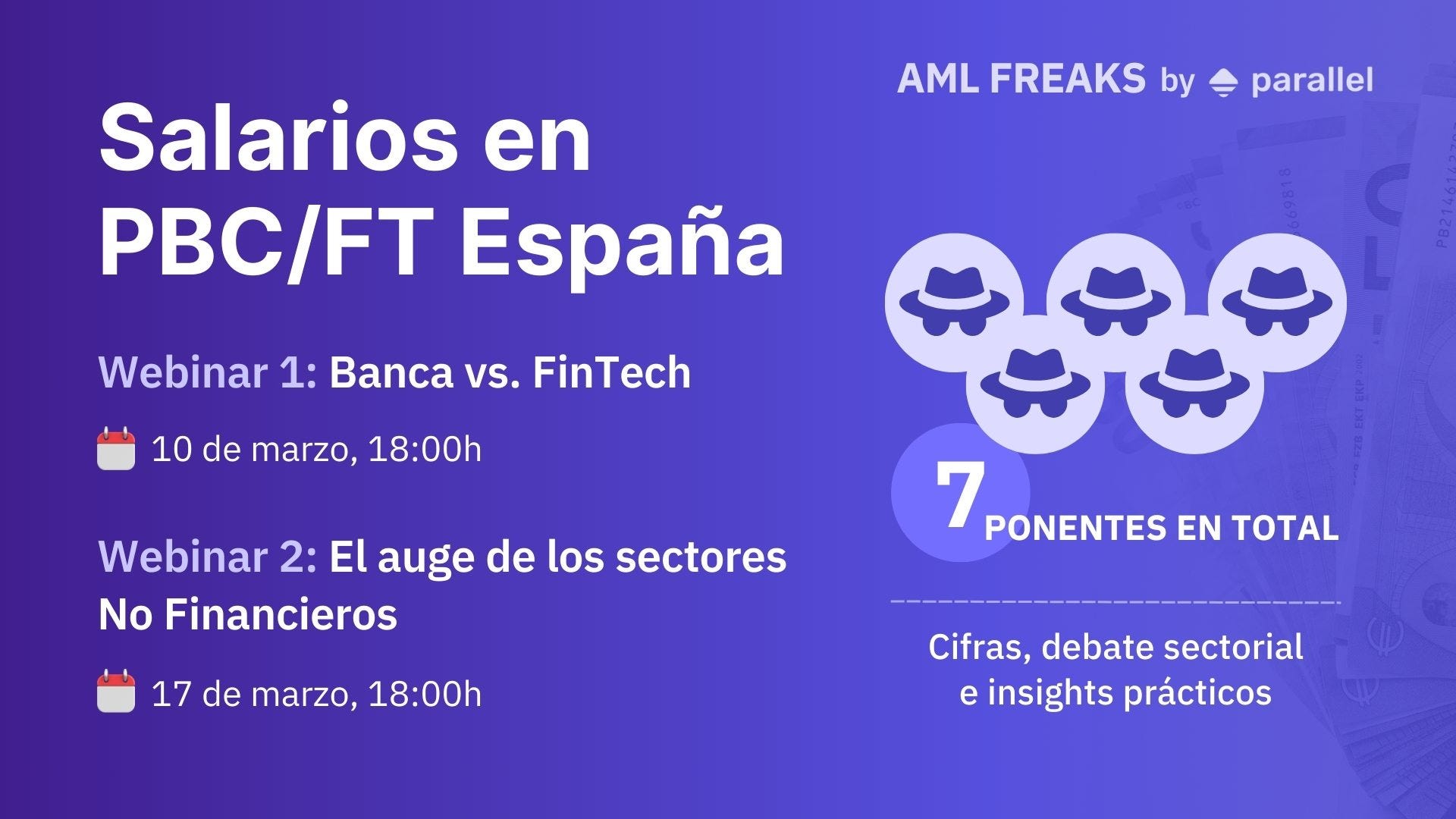
AML/CFT Salaries in Spain | Presented in Spanish
+400 professionals have participated in the largest AML/CFT Salary Study in Spain. We’re presenting the results to the community. Unfiltered figures. No taboos.
2 webinars · 7 AML leaders · March 10 & 17 at 18:00 (CET)
What advice would you give to someone preparing for a job interview in this field?
Pietro: I would first recommend staying constantly updated on new technologies and key developments in the industry. We are entering an increasingly complex era in finance, where digital currencies, blockchain, and digital assets will play an even more significant role in the coming years.
For anyone looking to work in AML/FinCrime, it’s essential to prepare for this shift which is already underway by developing a solid understanding of how these technologies work, the risks they pose, and how they affect traditional AML controls.
Ultimately, it’s not enough to just know current regulations: you need to be curious, proactive, and ready to adapt to a rapidly evolving landscape.
Based on your experience, what would you recommend to someone who’s about to negotiate their salary? What should they keep in mind?
Pietro: Of course, years of experience and having held coordination or leadership roles are strong assets when negotiating salary and can justify aiming higher.
However, as I mentioned earlier, AML is a constantly evolving field: showing that you are up to date with new developments especially in technology and regulation is equally important.
In addition, I believe that demonstrating a broader cultural perspective beyond purely economic and legal considerations is a real advantage in salary negotiations and a strong differentiator.
What skills and roles do you think will be most in demand in the AML/FinCrime space over the next few years?
Pietro: In the coming years, data analysis skills will be increasingly in demand in AML/FinCrime. Professionals will need to be comfortable working with large volumes of data, identifying patterns, and translating technical insights into compliance decisions within a risk-based framework.
For coordination and leadership roles, strong organizational and managerial skills will be essential including the ability to design and oversee processes, manage cross-functional teams, and collaborate with departments such as IT, Legal, Risk, and Business.
On the operational side, familiarity with advanced compliance software will be crucial, including transaction monitoring, screening, and case management tools particularly those leveraging artificial intelligence and analytics to operate effectively in an increasingly tech-driven environment.